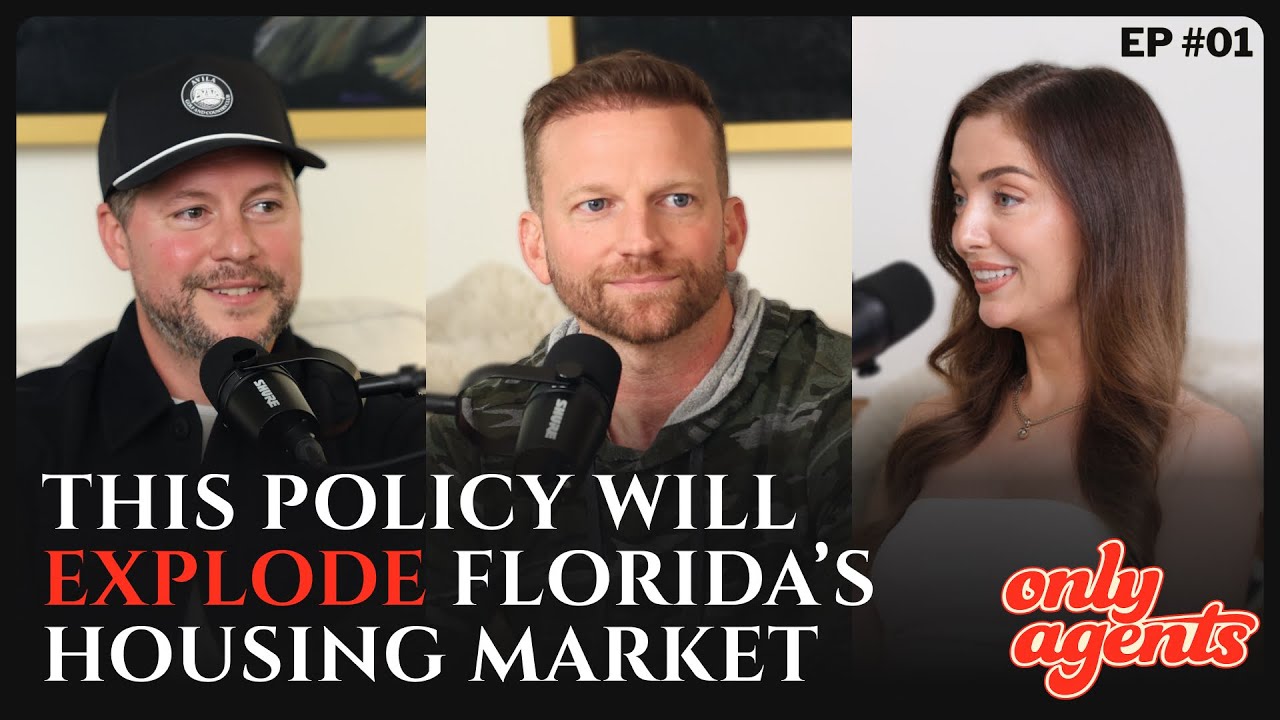
Christine: Welcome to our very first episode of our brand new podcast, Only Agents. My name is Christine Schonbrun. We're here with my husband, Alan Schonbrun, and our business partner, Stefan Alvarez. Hello. And we are the Alvarez Schonbrun Group. We are a group of three real estate agents who are local to Tampa. We are actually all born and raised in Tampa. We all grew up here. And same with Stefan's wife, Janina.
And the three of us, we came together about two years ago to start a luxury real estate sales team. We have had a ton of success in our first two years. Last year, our first year, we sold over 11 million. And this year we're on pace to sell over 24 million. So in this podcast, Only Agents, we plan to talk about real estate trends, what we're seeing happening in Tampa. We plan to share some of the behind the scenes of what it's been like to grow our business. And most excitingly, we'll be bringing you experts from around Tampa Bay. We'll be bringing on builders, lenders, designers, and those people who are truly shaping the future of Tampa Bay. So expect humor, expect a lot of data, and expect a little bit of spice because this business is not boring and neither are we. So pour yourself a cup of coffee, maybe a glass of wine, sit back, relax, and we appreciate you being here for our very first episode.
Alan: It's a quick shout out to our very real sponsor, AG1s. We are not sponsored. If you haven't been convinced by Joe Rogan or Andrew Huberman to have AG1s, maybe ASG can convince you. Minerals and vitamins that you get from one cup. You might start having the hairline of Stefan Alvarez or the jawline of me.
Christine: I would rather be sponsored by a Burgundian wine like Chassagne-Montrachet. So if any producers from Burgundy... send us a case of wine and then we will drink it during your show.
Alan: You know, we were thinking... We're debating naming our first son Chassagne.
Christine: We are absolutely not debating that right now. It's not a debate. It's absolutely not happening.
So for the record, we are not sponsored by AG1. We are not sponsored by anybody. First question, Stefan. You are a licensed attorney. You own a boutique title company here in South Tampa called Serenity Title. Alan, you have had a very successful career as a day trader in New York City for 16 years. Was that past tense or still present tense?
Alan: Have had. You do it on the side.
Christine: But I'm curious, what sparked or what happened in your lives that made you guys want to get into real estate, luxury real estate in South Tampa at this point in your lives and in your careers? Cause it's kind of giving midlife crisis, so...
Stefan: Geez. That cuts deep. You're not wrong though with the midlife crisis. It was more of like a mid-career crisis, at least for me. So I was a practicing litigator for almost 10, 11 years. I was at a big corporate practice. COVID happened. I always knew I wanted to start my own businesses. And so things slowed down a little bit during that COVID era for like a week at the corporate practice. And I realized like, if I don't do something different now, I probably will never do it. I'll get way too comfortable there. So I started my own law practice that year. Always knew I wanted to get into real estate eventually. The next business, shortly after starting the law firm, was the title company with my partners there. And then it's kind of quickly evolved. So almost every two years, I feel like I'm getting more and more ingrained in the real estate industry.
Sales was always in the back of my mind of wanting to start, but it was just about timing and also getting the title company business kind of settled and humming. And so two years ago, title business was really in a good spot. I also started seeing a lot of transactions, obviously. I mean, we close over a thousand transactions or more at the title company. And so I saw a lot of really bad agents, not all of them. There's a lot of good ones too, obviously in the industry, but just a lot of things happening in these transactions and the barrier to entry is so low. I think when you have a low barrier of entry job, people are like, well, I'll do it part-time. I saw that with day trading and then I've seen it with real estate. Anyone can be a day trader and anyone can be a real estate agent, but to be good, to be like top 1%, 5%, 10%, that's difficult.
It was just an industry that I feel like was prime for someone with professional background experience. A corporate experience I think also helps because for most people in the residential space, this is by far the biggest financial decision and transaction they will ever make. So it always blew my mind that you would have someone that's kind of part-time or the old joke like your cousin's uncle's sister who has a real estate license, like, yeah, they'll help me buy a million dollar home. As a favor, like you're giving them a favor by using them, but they're not doing anything. They're opening the door and they're writing an offer. So my thought was that it's just an industry that was ripe for disruption to come in and kind of fill that gap or void and bring the professional experiences, the access and platform of the title company, obviously the legal background, the financial background. And that's kind of how it started.
So how we teamed up, I was already starting to think about pivoting and starting the sales side of things. You guys had just really moved back from New York.
Alan: Yeah, New York and then Miami. I just got my license and the reason why I got my license, there's a few reasons. First, I was day trading in New York for 15 years. That was just a wonderful job. I never wanted to do something where I had a boss or my income was capped and I always wanted to be paid based on my performance. Being an athlete, that's kind of like, you don't want to make the same as the person next to you, even if you're a lot better. So day trading seemed like a great job and it was and then COVID hit and then New York kind of stunk. And I came down to Tampa, started day trading remotely, not going into like an office in New York City with a bunch of other degenerate gamblers, you know, it just felt lonely. And I was only kind of doing it a few hours a day and the rest of my day, I'm like, what am I supposed to be doing with my life? I didn't want to wake up as a 60-year-old day trader.
And so then kind of to jump on that, I had owned some property. We had done some transactions or we were in the middle of doing some transactions with agents and I'm like, we could disrupt this industry pretty easily. The reason I actually got my license though is I had gone to Turkey to get a hair transplant.
Christine: Oh, you're telling people this.
Alan: And I was, we were renting a place at the time waiting for our condo to be built. And I was just like moping around because I couldn't go out into the sun. I couldn't sweat. There's all these rules when you get a transplant. And so I'm like, I don't want to waste my time. So I'm like, I'm gonna get my real estate license. And I remember going to you and being like I'm gonna take a course, get my license. What am I gonna do with it? I'm not sure yet.
Christine: Well, a big reason you decided to do it is because we had just sold the condo at Hyde Park House and we had paid the agent a boatload of money. And I remember you saying, I'm gonna get my license just so I never have to pay another agent. I'll get my license so I can transact on all of our own real estate purchases for the rest of our lives.
Alan: I think a lot of people end up kind of getting a license to do that. So I got my license during that time and then we were at a Tampa Tomorrow event. That's right. Yeah, shout out to Tampa Tomorrow because that's kind of what brought us together. So Christine and I were there. Did we know you were going? No. No, I don't think so. So we ran into Stefan and Janina and I think in conversation I was like, by the way, I just got my license. That's right. What? I was like, dude, I'm about to start a sales company. Why don't we just team up and do this together? So I think that's how it was born. And that's the impetus of it.
Stefan: And then I mean, we were with Greco in the very beginning and then our old friend Garrett Greco came and met up with us at Forbici and was like, guys, I have a brokerage. I'm mostly doing commercial, but why don't you guys help build out a residential team?
Christine: Yeah, so what brokerage are you guys at? What's the background of South Cedar?
Stefan: We are at South Cedar Real Estate. Our friend who we went to Jesuit High School with here in Tampa, he started the brokerage at the time. He started really with his wife, his brother-in-law and his wife, and they were really using it to transact their own commercial investment portfolio. And then when we started the team, Greco noticed or saw that we started a team, reached out and said, I'm doing mostly commercial. Why don't you guys come over and bring kind of the residential piece or arm to the brokerage? And the brokerage is now quickly growing from there with more and more agents joining. It's very boutique. It allows us to stay really nimble as a team, which has always been my goal. I don't have any interest in starting a brokerage at all, because I've got enough stuff that keeps me awake at night with the title company. Lots of liability, lots of responsibility. It allows us to focus on what we are best at and that is the sales side and growing our team and finding the best agents and the best resources for our clients to be able to transact. And we've made one external hire, but we want to hire slow. We want it to feel like a close-knit family versus some of these other brokerages that just want to fill seats and to charge monthly fees. That's not our business model at all. And it's been fun, that's the best part.
I also got to a point in my career where I was miserable litigating and being in court every single day as a trial attorney. And so that was another big reason to get into real estate. I always knew whatever I was gonna do next, no matter what business, I wanted to do it with people I know, trust and love, and do it in a space that I'm just gonna have fun every single day if I can. I mean, don't get me wrong, things can get crazy obviously in real estate. But it's fun.
Christine: This sounds like the positive version of a midlife crisis that you guys figured it out. So I know we have some hot topics related to real estate that we want to touch on for this first episode. But before we get into that, I would love it if you guys could summarize, what are you guys seeing in the local Tampa market right now? Like who has the upper hand? Is it buyers or sellers? What are you seeing the difference between high-end luxury properties versus townhome and condos?
Alan: I mean, there's, it's like a bifurcated market. There's micro markets. If you're trying to sell a $4 million home, there's a lot less buyers for that. It can take a lot longer. If you're trying to sell a $1 million or one and a half million dollar South Tampa turnkey single family residence and you price it properly, you'll probably go under contract in the first week. You might get a bidding war.
Stefan: Yeah, I mean, I think it's safe to say it's turned. It's a buyer's market right now. Prices have cooled, including the micro markets, but like anything in real estate, if it's a great product, if it's priced well, it's gonna go quickly. I mean, we saw that with our listing in Bayshore Beautiful. It was a beautiful house. It was a great kind of starter home for a family wanting to get into the South Tampa market in a prime neighborhood like Bayshore Beautiful. And we priced it really, really well. We priced it just underneath, I think, the market and that made all the difference in the world. But we also have a great listing in an old condo that's turnkey, but there's no differentiation between that and the seven or eight other units that are available. And the HOAs are crazy. There's been special assessments in the past. And it doesn't matter almost for a listing like that. It's just there's not a lot of buyers for that. And there's a ton of inventory.
Alan: Yeah, I think that's almost not even a micro market. It's like a different asset class altogether, obviously. Not just a condo, but then a condo in an older building that's had to go through all the structural things that they had to do since the Champlain Towers collapsed and all the new requirements, all these HOAs, they didn't have the proper reserves. They weren't doing, they weren't running the business. They deferred all the maintenance for years and years to keep the HOAs low. And then all of a sudden the new law was passed and then all of a sudden they've got to send out these massive special assessments to owners. And they do that for any building that's three floors and up.
Stefan: These are legacy condo owners too, you gotta think. Not just in Tampa, but especially down South. These are condo owners that have had those units for like 40, 50 years and never had any sort of major increase in dues or special assessments. And most of those people are on a fixed income.
Alan: 100%. So it's a huge hit for them.
Stefan: And that's creating a ton of inventory.
Christine: Yeah, I couldn't agree more with everything that you guys brought up. And it brings my attention to this topic that we're really hearing a lot of, which is this potential for a second wave of high net worth individuals moving to states like Florida, Texas, from states like New York and California. So can you guys talk a little bit about why are people expecting that to happen? What policies are being passed in these different states that might be the cause of a lot of migration back down to Florida again?
Alan: I've been thinking about this a lot. Just you and I are going up to New York City in a couple of weeks and hang out with a lot of our friends that are still up there. It's like, why did we leave New York City? I mean, for years my friends when I was up in New York City would just be like, why are you in New York City? You're paying 13% in city and state taxes. You can trade from Tampa. Like why are you doing this? And I'd be like, you can't recreate the energy. New York City is the best city in the world. And I kept being like, well, if it costs an extra 15% of my income and if the cost of living is higher, that's like a price to pay. And I'm okay with that. I mean, we could be chilling at 3pm on a Wednesday and say, let's go to a Broadway show. Let's go see Hamilton. And then boom, we could do that. Let's go to the number one rated restaurant in the world. Let's go to Le Bernardin or Eleven Madison Park tonight. And you can do that. Or you can do the non-expensive things, but just there's so much energy. There's so much opportunity. You're filled with like all these ambitious people. And so we didn't leave until COVID hit. And that took away what New York was, like why New York was special. It took away the energy. It took away all the opportunity, at least for years. And Tampa and Florida got that.
And so when I'm thinking about Zoran Mamdani becoming the mayor, I mean, first of all, he can't pass a lot of things without the state legislature getting on board. But even if he passes something where it's like charging an extra 2% on millionaires personally, like on their personal income taxes, I think you will get some people that leave. It's not going to be COVID migration again, unless corporations leave. If businesses start coming down and setting up shop in like St. Pete or Clearwater or Tampa, which is already starting to happen. A lot of corporations are, yeah. Then people will come, then the migration will come. Or if it starts becoming very unsafe in New York City, which we're not going to bring politics into this, but if it becomes unsafe, if New York City changes drastically, or if corporations leave, then for sure we will have a kind of a COVID-type migration. But if it's just a slightly more expensive place, I don't think you'll see it the same way. I think Massachusetts a few years ago bumped up their taxes and that didn't do anything.
Stefan: I agree. I don't think there's going to be like a massive net migration unless the governor gets on board with some of these proposals and policy changes that he was touting during his campaign. But I do think the campaign alone and all of his talking points and media blitz with it, it's making people think about it, which I think is great because it's getting all those people putting their eyes on, okay, well, if we have to go, where would we go? And I think everyone, like during COVID, the natural direction is, hey, Florida, because at the same time as all this is going on in New York City, you've got our governor in Florida touting policies that would create a massive appeal for people to come here. It's the opposite.
Christine: Yeah, so I know we can talk about it later if we want, but I mean, just one policy alone, talking about eliminating property taxes.
Stefan: For homesteads, yeah. For homestead property owners, I mean, that's a huge incentive for people. I feel like your property taxes at this point, for our mortgage, it's 20% of our costs of the mortgage payment. It's a huge cost barrier, I think, for people to get into home ownership. I mean, what is it? Is it like 1.5% of the cost of the home? Yeah, but it also depends on the municipality and how costly and everything. But it's a lot, it's a big cost.
Christine: Well, what exactly has Ron DeSantis said about eliminating property taxes? Like how serious is he about this?
Stefan: I think he's serious. I mean, he's talked about putting it in front of voters, and I think all you need is 60%. I think the state legislature too, there's like seven different bills that have been proposed that are going through some form of debate in the legislature to support DeSantis's proposal to remove property taxes. Cause then obviously they need to come up with a system to reallocate that revenue or to figure out a way to get that revenue back locally.
Christine: So what are they proposing? How are they going to make up that revenue?
Alan: I think there's various ways they could do it. They can increase consumer taxes or tourism taxes, which obviously is like a main driver of our economy in Florida. Or businesses come down and they raise more money just organically through growth. Yeah, I mean, I think there's a number of different ways they can figure out how to cover that budget. And they're not taking away property taxes for second homes. That's part of the proposal. The schools will still be funded in a certain way, I think, in at least one of the bills that's going around. But it's just for homesteads.
Christine: So do you think this change would have a real impact on like the greater Florida real estate landscape or do you think it wouldn't really impact people other than those that have a homestead in Florida? Like does it make that big of a difference to people?
Alan: I think it would make a huge difference. I mean, I think the market shoots way up. I mean, that's just, people, it's almost like, you know, during COVID when everyone was getting just like free handouts. And then everyone became like a day trader or they started buying a property or just basically it causes inflation and all assets kind of go up because everyone has a lot more money.
Stefan: Yeah, 100%. And like I said earlier, I do think it would be a huge incentive for migration from places like New York, California, Illinois. We're certainly gonna be handing out a lot of business cards during the holiday party up in New York.
Christine: So speaking of other policies that are potentially being passed, we're also hearing a lot of rumblings about the 50-year mortgage. So who is the 50-year mortgage designed to help? Before we go into any of the challenges or the pitfalls of the 50-year mortgage.
Stefan: No, I'm joking when I say the banks, but the banks will benefit significantly from a 50-year mortgage if that ends up happening. But obviously the proposal from the president is to try to help with the affordability crisis throughout the country, especially in Florida for people that are just priced out of the market right now, wherever they may live. So that I think is the idea. That's how the 30-year mortgage I think came about too. Is it a right financial decision for a family or for an individual to take on a 50-year mortgage where the first 10 years, they're not touching the principal? To me, it almost creates, it turns a home into like a car because it becomes a depreciating asset. It's a huge gamble on the market and the price increase.
Alan: Somewhere out there Dave Ramsey, his head is exploding. Thinking of a 50-year mortgage. I mean, you're basically like, you're only paying interest. I mean, even on a 30-year, the first 10 years is mostly interest. So a 50-year, yeah. The interest it adds on, I mean, who's gonna live in a home for 50 years nowadays? Our parents, they would live in homes for 20 years, 30 years, at least mine did. But I think the older generation was less into the HGTV fix and flips where it's every five, six, seven years. So a 50-year just seems, I don't know. I think the idea too, one of the pitches for it is, hey, it's a great way if you can't afford getting into the home that you want, you can get into it and then in a year or two, you can always refinance into a conventional 30-year. I think if you're planning to refinance, then sure. It's a possible way to help. But at the same time, if you look at the numbers, you maybe save like a few hundred dollars between a 30-year and a 50-year. Your monthly savings is like what, 10%?
Stefan: But the problem is, okay, you save 10%, but then in a year is that asset class gonna be up by five or 10% and so basically your costs haven't gone down because now, so unless you already owned a place, people that already own the assets, they benefit from it, but if you're trying to get in it and you don't get in it in that first wave of everything kind of going up because of the 50-year, then instead of that $500,000 place that you're getting a 30-year, it now is worth 600,000. So you're getting a 50-year on the same place that's expensive or more expensive.
Alan: And I think you're just more exposed. If the market shifts in the wrong direction even a little bit, you're just, and you've seen that happen, I didn't even know this actually, but other, obviously we're not the first one to come up with the idea of a 50-year mortgage. There are countries in Europe that have done it. Japan has a hundred-year mortgage, which is insane to me.
Stefan: I think what it comes down to is we have an affordability problem everywhere and so the first-time home buyer right now, do you know how old they are? 40 years old now. First-time home buyer, average age 40. In 2021, it was like 33. And I think 20 or 30 years ago, it was like mid-20s or mid to high 20s. So we have an affordability problem because housing has gone up a ton. Insurance has gone up a ton. Education is, I mean, people are getting degrees that aren't giving them jobs after they graduate. And they're already hundreds of thousands of dollars in debt. And so you have all these pillars. Life is really, really expensive. And so, again, we have this affordability problem. And so governments are like, well, how do we revive the American dream of being able to own a home? And I feel like it's pretty lazy.
Christine: I mean, you guys seem pretty bearish. So is there any buyer you would recommend this for? Or is it a no across the board?
Stefan: It's such a personal financial decision, honestly. You need to bring on a trusted lender. What I would say, if you're asking me personally, no, I would never make that recommendation, in my opinion. But again, it really does depend on their personal situation and financial landscape, as to whether or not it's the right move for them. If there is a, if it's the right home and the right neighborhood and the potential for that property to hold its value or continue to appreciate over time, maybe it's okay for a short-term opportunity to get into the home. And then in a year or two, yeah, we get them with one of our preferred lenders to refinance into something that's a little more conventional. But I don't know, personally, I wouldn't recommend it.
Christine: Let's get a few more hot takes from you guys before we wrap up. This is gonna be a lightning round. So I'm gonna ask the question really quick. No looking at your phones. So at this time next year, do you think the market will be higher or lower, Stefan? Let's start with you. Our local market here in Tampa, especially South Tampa.
Stefan: Honestly, I think prices are gonna stay steady, maybe have a slight dip. But I do think that sales activity is gonna be much higher for sure. I think there's gonna be a lot more transactions. This year has been even less than last year. And I think these past two years are the lowest since before COVID. So I think transaction volume will increase. But I think prices are probably gonna stay leveled off here for a little bit.
Alan: I think for our hyper local market, we're fine. I think we're higher. I think we're higher by a decent amount. I just, I have faith in the Republicans trying to juice the economy going into the midterms. We're gonna have a new Fed chair come spring. I think it just behooves the administration right now to tackle this affordability problem.
Christine: So that was my next question. Interest rates at mid-2026, do you think they'll be higher or lower?
Stefan: Lower. Definitely lower.
Alan: Lower. I think interest rates are gonna be lower because I think they're artificially gonna be brought down. But that's not necessarily a good thing. If you think back, it's like the last couple of times that the government stepped in and said, we're just gonna drop interest rates quickly. It's because there's like catastrophe happening. You had the great financial crisis in 08. You had COVID in 2020. It's usually a sign that the basic market economics are not healthy. There's some underlying fundamental problem that they need to address. But I'm still bullish on our local market for sure. Throughout all of these things that are happening around us, I still think Tampa, I'm not sold on the, I know there's a lot of doomsayers out there that are saying we are due for a bubble here locally in Tampa. I don't see it. I don't think it's gonna happen. It's totally different than 08 in terms of housing.
Stefan: Yeah, because the fundamentals too are totally different things. We don't have people flipping home one year after one year after one year and every time they're selling the home, they're getting 20% higher and they're putting 0% down, they're not even looking at your income. Like none of that is happening. There's other bubbles, there's bubbles everywhere, but not Florida housing for sure.
Christine: So thinking about our local Tampa market, what neighborhood do you think is the best buy in 2026? And you can break it up for homes under one million and homes above one million.
Alan: I love Bayshore Beautiful, which is in your backyard. I don't understand why Bayshore Beautiful is not a lot more expensive. I know a lot of people are driven for their home decision by the school district. And only half of Bayshore Beautiful is Plant. So yeah, there's parts of Bayshore that are outside of Plant district, but I mean, if I'm really looking kind of like a five to seven year horizon for an upside for somebody, that's where I'd go.
Stefan: You're gonna say West Tampa or Midtown, aren't you? I'm gonna say all those places. But if you can wait it out, get something now in the old West Tampa neighborhood, which is on the west side of the river, kind of same areas as the Heights. I think kind of like what happened with Tampa Heights over the last 10 years is gonna start happening in old West Tampa. It's a little bit different because the lots are really tiny over there, but there's the West River expansion that's happening right now. You've got Rome Yard Development, which is right on the river, and that backs into the old West Tampa neighborhood. And they're doing some really high-end multifamily around there with like an Armature-type commercial space in the center of it. So that whole area is gonna become a massive, massive opportunity. It's gonna become very walkable. You'll be able to walk from your house to that Rome Yard Development, then hop on the river walk and then head over to Armature, to downtown, all the way to Bayshore. This is all part of the reason why, by the way, I don't think that there's a bubble happening in Tampa because I don't see these projects. I mean, with the developers that we have behind these things and the amount of just momentum the city has with the local projects like the river expansion, I don't think we're in a bubble.
Christine: One other one we had was, if you had $1 million to deploy in the next 30 days, what are you buying?
Alan: Bitcoin. Bitcoin. Bitcoin. You could only buy eight Bitcoin for $1 million like a month and a half ago, and now you can buy 12. You get four free Bitcoin.
Christine: I'm going to wait. I think it's going to keep going down.
Alan: Don't say that. You'll make him cry. That's his only long position.
Stefan: No, that's funny you guys have a question that we're helping somebody right now that's basically looking to deploy $1 million before the end of the year. Tax implications. Yeah, it's a great problem to have. So what are you recommending they do? Something that earns them some income until they figure out how to redevelop it. So it's kind of like short term cash flow, long term, ground up. Yeah, so maybe like a single family that's got an opportunity for increased density or future land use on it down the road. So he can put a tenant in there from day one, cash flow, address the tax implication issue that he's dealing with this year, and then we can help him kind of go through if we need to rezone. Ideally, we find something that's got already the future land use in place, but get a rezone to then maybe maximize the value of that land by putting some increased multifamily units on it or something like that.
Christine: All right guys. Well, that is our first podcast. Again, we want to thank you guys for tuning in to our very first podcast. You can find us on Instagram at asg.luxurytampa and on YouTube at the Alvarez-Schonbrun Group. We plan on releasing these podcasts once a month. So tune back in. And we'll have some special guests on these moving forward. It won't just be us blabbering on about things. We'll have some really unique, fun guests to talk about real estate, specific things. Other business owners maybe in the local community.
Alan: We had to hold Alan back this time from bringing the wine. A breakfast wine. That's an aligote. In Burgundy, you get served aligote which is not the good wine. It's table wine. It's wine you drink at 10 a.m. and you kind of mix it with other stuff. They serve those aligotes. Don't get upcharged aligote at a restaurant. And if you take anything away from this podcast, that's it. Who cares about real estate? Just don't get upcharged. Aligote, not agote. All right. We'll see you guys next time.