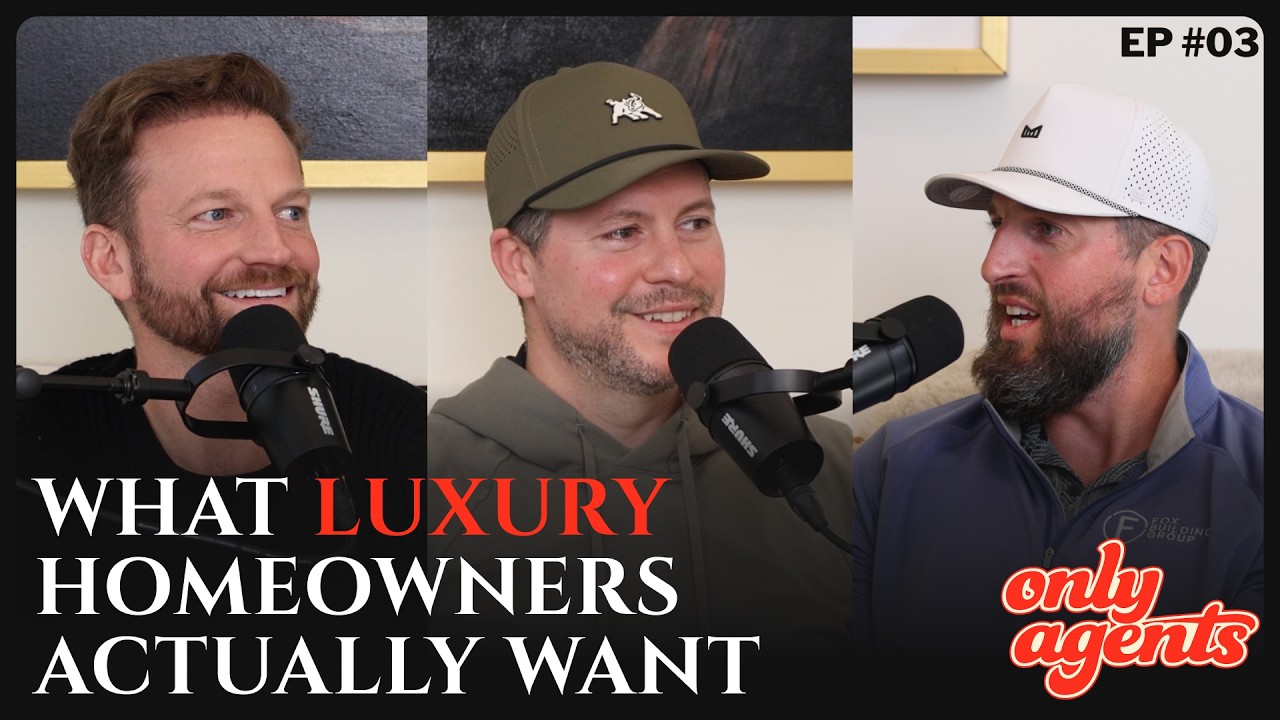
Christine: Welcome to episode three of ASG's podcast, Only Agents. I'm here as usual with the S to my A, Alan Schonbrun of Alvarez Schonbrun Group. And today we are lucky enough to be joined by a friend and a pillar of the building industry in Tampa Bay, Mike Fox, president of Fox Building Group. How are you, man?
Mike: I'm doing well, man. Thanks for having me.
Christine: And real quick, we always get sponsored by people. Well, that's right. Moment for the sponsor. We have a sponsor.
Alan: Well, episode one, we had AG1s, fake sponsor. And then in episode two, the whole country of Germany sponsored us. That was a big one. But in particular, it was the Rhine River region, Moselle, all the German Rieslings that are there. But for episode three, now golf season's back. LIV is just throwing money around. So I figured maybe we could shout out LIV
Golf, and maybe they could sponsor us. You know, Bryson is trying to get like $500 million now. I saw that request. After the departure of Patrick Reed and Brooks Koepka. So I don't know if anyone can maybe get a set of meeting for us.
Christine: Mike, do you have any, do you have an in? Do you golf?
Mike: I'll try to, man. Terrible, I feel like. But I enjoyed it, I guess, even though I just leave every time pissed off. My wife's like, why do you do this again? It's awesome. I enjoyed it. It's the best. I'm going to the Waste Management tour this weekend. I'll be at the 16th hole in the box on a Friday. But my buddies are like, let's golf on Saturday. They booked two tee times. They want to golf 36 holes. And I'm like, you guys. That's crazy. That's too much golf.
Alan: LIV Golf, if you're listening and you have extra cash, send it ASG's way. I'm sure the PIF will consider.
Christine: Well, yeah, officially welcome to the podcast. Thank you again for joining us. We really, really appreciate it. We're excited to have an in-depth conversation with you. But for those of the viewers and listeners that don't know you, why don't you kind of give us a brief introduction about who you are and who Fox Building Group is?
Mike: From Maryland originally. I graduated from West Virginia University. Let's go Mountaineers. Civil Engineering, actually Mining Engineering. Worked in a coal mine for two summers, which was an interesting experience. Really great experience, honestly, when it comes to every skill I learned from my interpersonal skills, especially in the industry, that was a valuable life lesson.
Alan: Was it one of those things where you learned like, this is definitely not what I want to do?
Mike: Yeah, 100%. There was an incident at one of the adjacent mines where three people had passed away. My mom basically said, you're not doing this, which I had to agree, there was a little bit of fear there. I went to work at kind of the hometown company in Baltimore, Whiting Turner. If you aren't familiar, it's one of the largest private companies in the United States, 5,000 employees, 110 years old. Really, when it comes to construction management, there's no one better. I really think that gave me the education that it took to take this step that I ended up taking. But how did I get there? I guess COVID was a big catalyst. I was living in Baltimore. It was a lonely time, right? Unlike the South, it was pretty locked down. Spent a lot of time in our apartment, really just like thinking about life and what I really wanted out of life. And two of my best friends, they put me on a reading list starting with this book called Living with the Seal by Jesse Itzler.
Alan: That's a great book.
Mike: Yeah. If you're not familiar, Jesse Itzler, serial entrepreneur married to, I believe the first female billionaire. Sarah Blakely, founder of Spanx. Jesse founded Marquis Jet, Zico Coconut Water, I believe. Serial entrepreneur, wrote the song for the New York Knicks, wrote the song for the Denver Broncos. And it really inspired me to take a leap, right? Take a leap of faith. So I think the true catalyst was we had a bullet come through our window. Baltimore is a really challenging place to live. The Wire is a documentary more than fairytale. So I was like, I've had this in my mind. Always want to be an entrepreneur. How do we put that plan in motion? Probably don't want to do it in Baltimore given we don't want to live there. So I looked at Urban Land Institute's top five emerging markets. Wanted to go somewhere that's on a big pattern for growth. We looked at Nashville. We looked at Tampa. We looked at Charlotte. And we went to Tampa.
Alan: Oh, man. I was younger at this point. How old was I? I was under 30. Went to MacDinton's during COVID.
Christine: Nothing like a welcome to Tampa by going out to MacDinton's.
Alan: I met my wife at MacDinton's. So it's not all bad.
Mike: COVID's locked down in Baltimore. There's a thousand people here. Like couldn't get enough people in here. And I was like, honey, this is awesome. We're moving here. So next thing you know, I transfer in with Whiting Turner to the Tampa office. Whiting Turner has an office generally in every major city. And went from spending a lot of time in residential multifamily, multi-unit construction. I did a hotel couple, multi-family high rise, five story, four story. Just generally multi-unit construction is what I did to working on pharmaceutical projects here in Tampa. So a complete different change of pace. Cool work, but really wasn't where I wanted the niche down. And on the side, nights, I was studying for my CGC, the certified general contracting license. The highest license in Florida, which was a challenge. And next thing you know, got the license. And now we have fast forward four years later. We have 18 employees here based out of Hyde Park at the foot of the Davis Island Bridge. And yeah, it's been crazy, man. It's been a run.
Alan: Was there anything that you saw, other than obviously you said you knew you always want to start your own business, but was there anything in the market or that you were seeing from other builders and developers that you were like, oh, I could do this, or I could do this better or do it different?
Mike: Yeah. I mean, so I guess the company itself, right? I thought, OK, I have this idea. I'm not going to reinvent the wheel. I think I learned from the best at Whiting Turner. Like I said, 5,000 employees, 110 years old for a reason. Like they do things the right way when it comes to building. I think there's probably 10 companies in the world that can build a billion dollar project. And they're one of them, right? The systems, the processes are so absolutely dialed. So I wasn't doing anything new. I was kind of taking what I learned and wanted to do it my own way. I wanted to do it in my community. I wanted it to be more people focused. I wanted it to be in the place I love, I live and, you know, shaping my community.
I quickly realized that there's a significant gap in this market, I felt like. The typical home-builder doesn't follow the same process as a commercial general contractor. And that process is put in place for a reason, right? Like, the checks and balances, the systems that we do are standardized, right? You know, name the top 25 companies. They all generally work kind of the same way. And it's a science. It's set up that way for a reason. And that just didn't exist in home-building. So I found that there's a gap that, you know, I think that there's a lot of things we've learned that could apply to make this process, you know, just better for everyone involved, from the architects to the client, the homeowner, to deliver the project in a way that we can all be friends at the end of the day after doing so.
Fast-forward, that's where we've really tried to find that niche of where we can add value as a builder that can deliver projects that I think few can. These crazy, absolutely one-off mansions, the way that few can. And we have the ability to work through the details and the level of management we put into these homes and the knowledge and the expertise that we have from that level, I think it's a different way of doing things, but I think there is a demand and an ask for in the marketplace for it.
Christine: Yeah. I mean, systems and processes, when you're like an entrepreneur, it's a different beast, versus like just working at a big company where all the systems and processes are hopefully like in place. So, when you were starting to hire out people, you have 18 people now, I mean, when did you start hiring people to build out the systems so that, you know, the front-facing of the business can work really well? Who were your first hires, I guess?
Mike: Yeah, I mean, immediately, right? Like, I realized I couldn't wear every hat. It's funny how I got my first job back to Scottsdale. When I started the company, I was like, I'm doing this 100% with a clear head, right? Went to a party in Scottsdale. It was actually a Gopuff launch party, if you're familiar with the app. In Scottsdale, Brody Jenner was DJing, like random, but I'll never forget it. Was at the party, and met a guy. Long story short, he was like, well, what do you do? And I was like, you know, general contractor looking to start my own business, you know, background in multifamily. He's like, I invest in multifamily. I'm looking at the Tampa market. He was like, do you want to grab coffee tomorrow? I was like, sure. And next thing you know, fast forward. I introduced him to a brokerage and we found a little 16 unit apartment building in Hyde Park. And I was like, this is what I got for now and it's going to come due in 12 months. Either I'm going to be in horrible financial stress at this point or bankrupt or whatever. We're going to figure this thing out. So totally different conversations. But yeah, it was figured out.
I didn't have much to my name. So I'm like, how am I going to hire an employee? You know, I have this job going on, but it can't really support multiple people. So I need to find somebody to take a bet on me. I went to one of my best friends and made him an offer. He started considering a move for like six months. We ended up landing our second client, who's been one of my biggest mentors, another 12 unit apartment building in St. Pete. And I was telling Mike, I was like, Hey man, like taking a hire somebody. Like I really don't know what to do. Like I got to get him to move from Maryland. Like he was like, I'll give him an apartment for a year. And I was like, thank you. That makes the conversation a lot easier. So I was like, hey, free place to stay for a year, man, come down to Tampa. And next thing, you know, he joined me. So it's been several people like this and like I can't speak positively enough about the Tampa community, where there's a lot of first generation entrepreneurs that have been in my life that have given me a chance. I mean, David Kilcoin gave me an office for a year for free. Wouldn't have been there, wouldn't been in the seat without it. You know, there's been these people that have like helped us along the way that, you know, it just changed the whole course and trajectory of my company.
Alan: To your point, what you said about these like first generation entrepreneurs that have come to the Tampa Bay area. I've seen it. I think we've witnessed it, you know, close and personal. It's very cool to see how one, they're all gravitating towards the Tampa Bay area and market, but then that they're all doing what you're saying they did for you, which is collaborating and helping one another so that they can all kind of grow and be successful together, which is really cool.
Mike: Absolutely. And you know, we're working on both these clients projects. I think we added a lot of value. And we really went well above and beyond for them. And we're still close friends this day. Like it's just, you know, I think it's a byproduct of the area.
Christine: You mentioned scale up. So in your mind for the vision for the company, when you say scale up, what do you guys, what is like right now look like? And then what is the next kind of stage of Fox Building Group look like?
Mike: Well, what the next step really is, is finding the core skill set of the people that we have and the things that they are passionate about and putting them in the places where they can succeed. We're starting to put people as, whatever they're building, they're hyper focused on. My old firm, I go back to it a lot, but, you know, we had something called industry excellence groups. There was these really hyper focused groups for different types of building that really drilled down and got really skilled and talented at exactly that product that they were building. So of course, across commercial spectrum, we're starting to do that. And then this home building division is now its own thing. FBG Homes, you'll see, it is its own thing, leadership slightly different. Still rolls up to me. I hired my number two Dom, you know, he built like 30 Targets up in the Northeast, right? I wanted him to be my retail leader. That's where we're going for big-box retail. Multifamily is obviously mine. I've built a team around that. And then by the way, hey, we built some homes. I got really interested in home building. It's cool, right? You're building somewhere somebody's place where they're going to have a family, raise a family, somewhere that they're super passionate about with super intricate details, especially when you get to this upper echelon. It's just very creative and it like turns my gears a different way. And we have people that are passionate about it. I want to put them in the place to succeed there and build a structure that works for that. So it's a lot of the same processes, you know, the accounting, the quality management, all that's kind of the same. It's just like getting the people that are passionate about what they're building in the right spot. So that's what we're doing currently and that's where we're headed.
Christine: When I first met you, Mike, it was a couple of years ago and I met you, I think alongside your wife, Summer. I think at the time, I don't even know if you were engaged yet. But what's kind of what related all of us together is my wife works with us in ASG, Janina works with us in ASG, and I know Summer brings her set of skills and I know she does a lot with you guys. She's an interior designer. So, you know, how did that work out in terms of, you know, having you and your wife work together, you know, just pros and cons and synergies?
Mike: It was a learned thing at first, right? Like how to separate the business from family life. I think it was a little bit of butting heads at first, but like the less I got involved with the day-to-day, I think helped a lot. And like we learned, you know, there's a time for business, there's a time for our family, and I think that helped a lot and a clear delineation line. Because it's easy to blur those lines when you're with that person 24/7. And we're both passionate about what we do, right? But there's sometimes you just need to drop work. And I think it's much easier now with the baby. One of my 2026 goals is three nights after 6 p.m., we'll have our phones in our Faraday satchels, things like that. I'm a slave to the notifications. If I get a notification or a bing or a ding, I'm on it. And it used to be really bad. It used to be like wake up at like 2 a.m., 3 a.m. sometimes. And I'd check my phone first thing when I'd open my eyes. So I put it in a satchel now, it's like a bag which you put it in, like it's supposed to keep the EMFs out. But it's also like out of sight, out of mind kind of thing.
Alan: Yeah, that sounds like something Christine would do. She might have actually like turned off our Wi-Fi.
Mike: But our working relationship, I mean, there is a ton of synergies. Like, and it's worked out well. I mean, we work with other firms, but she's able to understand the inner workings of our business and what we need to thrive and succeed on these residential builds that she's on. She's been more focused on residential lately. You know, she's working with our budgets. So we're like able to, you know, obviously a lot of difficult conversations around, you know, construction in general, but more residential is the budget, the money, right?
You know, and it's hard because I think commercial is very defined, right? You know, I get a set of drawings. Everything I need to know about that project is there. And if I have a question, it's just direct to the architect and engineer, and that problem's solved. And it's a B2B transaction, right? It's not emotional for the most part. It's just, hey, you know, what do you guys need to get this space operational? Versus, hey, we're going to live here. And like, you know, I was telling you earlier, I tell my clients, hey, don't change your mind a lot if you want this to go quickly. But then I'm building my personal house now. And now I'm changing my mind. I've changed the drawings three times. And I'm like, I get it. You're going to live here. And you know, this is maybe their forever home. Like you want it to be exactly the way you want it.
Alan: So for the residential builds, it's probably a mix between, I guess, spec builds and then custom, you're building it for the actual homeowner?
Mike: Most of what we build. So when I define residential, it's the FBG Homes division is single family residential. We do some for sale townhomes, which are more spec builds there to be sold, that's more of the commercial division. But FBG Homes is really just single family builds. And yes, there are a few spec homes in there. Not for myself. We build for developers. We eventually, we likely will build some specs for ourselves, but it's just not where we're focused. I would like to stay in my lane for the most part. That's kind of where my head's at. So yeah, single family is primarily customs, but there is a few spec homes mixed in there too for developers that are going to sell it themselves, not us.
Alan: And then for those custom builds, with obviously having someone like Summer on the team and being able to lean into her design side of things, is she coming in like out the gate on the architectural design planning stage?
Mike: Ideally, yes. Our perfect world, she's involved on the front end and helps develop something we call like a bid spec sheet that defines at least some level of finishes that go in your home. Generally everything, every home we build is generally, you know, for sale probably over 4 million, at least 4 million, you know. And we kind of set non-negotiables almost with our clients. I would give flexibility, sure, but like, at that level, we know what that house is asking for and she can help take them there. Like, it's probably going to have Wolf Sub-Zero, Cove Appliances, or Thermador, you know, it's going to be at that upper echelon that we're going to start our budget with and, you know, she can help guide them. That way we have an accurate budget that she knows what they have to spend throughout. We're going to start here and end here type conversation versus everything's an upgrade. And like, does that price us out of the marketplace somewhat? Maybe, but like, I think we're realizing that's the area we probably want to play in. And maybe only do a handful of homes a year, but we're going to do the homes where we can add a lot of value because it's a lot of concierge, white glove touch service.
Alan: So what are you seeing the consumers that are in that price point, four or five, six million plus, what are they wanting in their homes that's different than the one to two million dollar spec homes that are being built? Like home theaters, you know, massive hidden pantries in the kitchen. Like what are those cool design items?
Mike: The answer is everything. But then it's like, no, it's a good question. It's really tailored to the personality of the individuals. Right. And it can be super custom elements, right? You'll have your standard. Yeah, you have a full butler's pantry. Like that's more of a chef's kitchen because they may not cook for themselves, right? Things you don't really think about. There might be full home automation. There's a thing called Josh AI where I can literally, you know, start to have machine learning, figuring out how I live in my space and start tailoring lighting scenes for, you know, what you do at that given time of day. So then you have integrated lighting controls and AV controls. Turn on your music at a certain hour. You know, all that home automation integration. I think of Tony Stark's house in the first Iron Man. I love that house and I love that scene when he wakes up and the window shades go up. Motorized roller shades. And those are the things people don't realize. Those aren't things you add on later on. These are very early on decisions that need to be made. And we guide our customers through the pre-wiring and, you know, understanding that a low voltage package in the house can range from 10 grand to 200 grand, depending on what you want. If you want the full motorized roller shades, AV, integrated light controls where your whole house is on your phone or an iPad. Like you've got to really pre-plan for this stuff and have the budget to do so. But the custom stuff gets crazy too, man. Like, figuring out things that maybe nobody's done before. You know, we had a dog bowl filler, like you have a pot filler in your kitchen at the dog bowls that were integrated part of the kitchen island. We had a shower seat that was custom, CNC milled for the exact body type of one of our clients in his shower.
Alan: Just to, like, sit down in the shower? Like, when you're wealthy, you don't stand when you shower.
Mike: Well, and you also get the seat molded to your exact specifications? Correct. So we're talking about cheekage. Like, they molded this. No, it didn't have like, an indentation. But it followed, like, the curvature of his body laying in the seat, you know, and, yeah, the shower had two steam generators. I can steam it out in 10 seconds, you know. These really custom one-off elements that, you know, something they care about in their daily life that they want their home tailored to.
Alan: So for these custom builds, I mean, what's been the coolest or most difficult construction element that you've been faced with or had to try to figure out on the construction side?
Mike: That shower seat was not easy. And like figuring out how all the tile sloped, you know, for this massive, like, I forget the exact dimensions. So it was, I think, net, like, 200 square foot shower. Like it was huge. You know, it's, uh, that was my first New York City apartment. Just a different detail, but like, we had all the baseboards in the home light up like a movie theater. Like that was one thing that was like an intricate element that we hadn't done before. And what does that mean? You had to get the floor perfectly flat to align with the track of the baseboard. And just a different level of quality that you had to go to. And that's something you're figuring out at the slab stage, right? Yes. You had to figure out like the concrete slab work. Well, this meant the floor tile had to go down before you drywall, which is totally different, right? Like, because you had to get it perfectly flat, and then the track met the floor tile. Then you finished the drywall because the baseboard track was mudded into the drywall. So it was just, you know, it's just interesting details like that that aren't typical of every home. Just slap some baseboard and, you know, it is what it is.
So, it's just getting into like that highest end where people want everything considered, right? Do you want the no-case doors, like basically you have no door casing where it's just a mud-in finish to the door frame. We're seeing that a lot now. And that's one of my wife's favorite features or she loves it. She does not like casing. I mean, that is the modern detail. And they have the no baseboard look with just like the reglet where you finished up, you know, basically drywall above and below. Like that is the upper echelon. Like it's what I've seen on like Palm Beach homes, which I think is where we're trending towards, right? Like we are a discount Miami, South Florida, still, on the cost per square foot basis.
Alan: So are you mainly just doing Hillsborough County and Pinellas County for like for the single family residences? Which county out of the two that you work in now in the Tampa area is like the easiest one, less red tape?
Mike: Honestly, Belleair is great. The beaches. I mean, it's a smaller municipalities which can have their challenges, but also the benefits that, you know, things can move a little bit faster with less red tape. But yeah, I mean, they're all challenged right now. Like, I'm not going to sit here and point fingers. Like it's just, you know, we're inundated with two major hurricanes in 12 months. Like I get it. Like, I mean, two major hurricanes in two weeks, really. And already understaffed departments in all these municipalities. It is tough. They're bombarded now with all of the new builds from, you know, cleaning up this hurricane. So like I totally understand and Adalia, you know, I feel like isn't talked about enough. That impacted me. It's really been three major hurricanes. So like I get it. But yeah, I mean, they both have, you know, both of the bigger jurisdictions, whether it's the city of Tampa or city of St. Pete definitely have their challenges right now. But I feel like we're working through them and things are getting better.
Alan: So I mean, in that pre-planning or pre-construction process, what is like the biggest hurdle or biggest time suck? Because obviously that's a big complaint from a lot of people in the community and anyone building their own home, obviously, is timeline, timeline, timeline. And a lot of things are outside of your control or hands. So is there something in the pre-planning or permitting process that is a big hold-up right now?
Mike: Yeah. No, I mean, yeah. It's all of it, right? Like, you know, we obviously, we build a lot of waterfront homes and there's a lot of due diligence items that you need to cover on the front end that, you know, we're having significant wait times, which are all getting better now. I think there's a little more of a challenge when the initial, you know, the blowback from the hurricanes. But, you know, it was waiting on a geotech report, you know, getting somebody out there to do soil borings, you know, been told of two, three months with some providers. I mean, we had great relationships and we got people out there pretty quickly. And then, yeah, I mean, it's just permitting as it's been a challenge. I always preach hire a good architect. That's your first line of defense, right?
Christine: That's gonna be one of my next questions, actually. Was, yeah, the architects you've worked with and if you've noticed a difference between working with local architects or designers and then maybe out of state architects or designers?
Mike: I mean, Florida is a challenge, right? When anybody comes out of state and tries to build here, it is a totally different environment, especially if you're building coastal. I mean, just terms I've never heard of before, you know, when it comes to FEMA and building an elevated home, like it's a whole different animal. But, you know, it's, I really say with design, and I really can't preach it enough, like those guys and gals don't get paid enough. Like there's so much work that goes into it and hire somebody that you trust, understand their scope of services and their level of involvement. You do have to pay for the things like nothing comes for free. And, you know, I can't say out of state is even bad because I know some really talented architects in the market that came into the market with like a really high level of design. That's what I was going to say is I think sometimes, you know, being in the industry and we obviously walk and we sell a lot of spec builds and a lot of them are beautiful. But then because it's a speculative build, they want to, obviously they want to work within the confines of the budget and the margin and they want to hit their exit. I think it's great if we can get more out of state or out of market designers to come in and be a part of the architectural community in the Tampa Bay area because yeah, I think the, I think our community is thirsty for more unique designs.
Well, and the white boxes are going to continue until, you know, until people stop buying them. Until people stop buying them, until there's a surplus. And, you know, I really think that, you know, there's, especially in a challenging market right now, you give a little bit more on the front end and like I said, I'm not a developer, don't claim to be, but like the ones that I've seen have massive success, you know, a few of my clients very much do. It's, I mean, Will Conroy, I think, I can't say enough about how much value he gives for, you know, whatever return he gets, you know, I think he's given well above what comps in the marketplace are giving and I think it's a testament to why his stuff moves, you know, and why he continues to because the design is, you know, he's design forward and he is really putting way more value. I mean, he had elevators, you know, he was giving when, you know, that price point really wasn't really asking for that. A lot of comps didn't have that things like that. These are the same conversations we have with the developers and builders that we work with when we have the opportunity or ability to collaborate at that stage with them on a project is you're probably going to get more on the exit. If you spend a little bit more on doing something, yeah, if you're doing a boring white box now, you're going to be at the very low end of new construction sales. Right. And that is a business for some builders and that's fine. But if you're trying to sell something for three million plus, a white box isn't going to get it done.
And for me, like I said, I'm not building spec. I will build spec. Like I have a brand that I'm trying to build and maintain, right? And I don't want to be signed up for the white boxes, right? I want to build something that we're proud of. And I'm just very much of the business and anybody that's worked with me, I'd rather hit singles and doubles. I don't need a home run on every deal because we're here for the long haul. And, you know, eventually those incremental wins will turn into, you know, a substantial longstanding business over time. So, yeah. And like I said, like I think giving more value on the front end, you might reduce margin at the end of the day, but like, you might get a quicker exit on the back end. I think that's a better strategy. And like you said, you can be proud of it at the end of the day. Like I think we all want a little bit of that. We want to be known in the community for quality.
Christine: So I think the market's shifting too. I think you can do, you can accomplish both. You can accomplish the business goal of, you know, making money and hitting a healthy margin on the project, but also staying true to your brand identity to your point what you're saying as, as a developer or builder and doing something that's a little more unique outside the box, the buyers are going to come. And it's, I think the, the market is trending in that direction from a buyer standpoint and then also from a design standpoint. Sure. Even some of the spec guys that used to do more kind of simple, you know, the white box aesthetic, they, they are now starting to put more products out to the market that are a little more designed forward, a little more unique, a little more daring on some of the design components and, and it's working. They're, they're selling them.
Alan: In terms of cost, how have you seen the effect of tariffs if, I mean, is it overblown? You know, you see the headlines and, and obviously it's very politically charged. And obviously, since COVID, you know, the cost of everything has gone way up, but tariffs in particular, you know, what do you think is something to worry about or?
Mike: I mean, tariffs, I mean, there was an impact on aluminum that hit windows, things like that. And we have a lot of aluminum windows in our, in our projects. Steel was real. You know, there was a lot of tangible increases. There was a lot of noise. And I think there was a little bit of opportunism as well for people to continue to drive an inflated price upwards in terms of building materials. I think we've definitely, I mean, anybody knows it, right? Like there's been a softening in the residential housing market. Like, yeah, I think we've seen some relief lately, like numbers I've seen as of last week are better than I expected. So I think we'll continue to see that. But hey, I mean, if there's a boom again, like I, I think they'll go right back up, which continues to make these. Prices never seem to go down. No, once they hit a certain amount, then they stay. Yeah. I mean, there's a lumber, lumber issue now with Canadian lumber. I'm sure you've said, shutting down mills. We got an alert about that last week. I don't know. I heard a little bit. I don't want to freak anybody out, but like that, that appears to be real. So I don't have actual numbers to support it yet, but like those things are happening. It's, it's a challenging time. And you know, we want, our clients want us to hold their prices as long as we can, but it's, it's 30 days. And if it keeps going like this, you know, I pray we don't get back to COVID times where we're holding a price for 10 days. And you know, you got to make a decision.
Christine: I'm not involved in that level of the process. So how does that process work? How easy is it to, to shop materials and suppliers? I mean, or is it kind of like you have your, your two or three suppliers that you typically are purchasing materials from?
Mike: I mean, we are now at the scale, which I think is where we can add value and have the same, deliver the same amount of value for a more competitive price, where we can start going out to our suppliers and say, hey, I bought X millions dollars worth of windows from you this year. Like, give me a discount. And we have one, you know, at least one, I think a second, but I'm still watching numbers these days. But we went out to them and said, hey, you know, we have the buying power. You know, we're not a Lennar or Horton built, you know, with the, the type of volume they do, but we're not a small shop either. Like we, we do, we are spending seven figures plus on building materials now. So like, I think that's something now, be able to reduce our price, but still provide the same amount of value because we pass that along to our clients. Right. So, yeah, we haven't just, you know, optimize that in margins, where a lot of others have, you know, we, we've taken our discounts we get from every single supplier and pass them directly to our clients. And they hold the prices for 30 days right now? Generally, that's what we hold 30. I mean, that's pretty typical of the industry. During COVID times, it was more like 10. Oh yeah. I mean, at COVID it was, you know, people were holding like same day type thing. And it's, it's difficult because the second a client tells us to go, we have to go through our procurement process. If I'm signing, I'm fully certain of what I'm buying. Right. So like it, it's a procurement process where I need to make sure this quote is fully validated. And when somebody's up against you with some kind of escalation factor or some kind of tariff or outside noise, it's just a challenge for us because we, we have to cut purchase orders and subcontracts very quickly to make sure we mitigate any impacts to, to our clients bottom line or ours, right? If we're at risk where we don't have escalation, which is, you know, kind of standard most for our contracts, but we don't want, we don't want that conversation for anybody. We want to do our best interest for our clients and not have them spend unnecessary dollars if we can.
Christine: So we've talked a lot about the building process and what goes into it. Why don't we talk a little bit about current projects you have in the works right now? What do you currently have going up in the residential space?
Mike: Ah, this is funny that architect called me this morning and I was like, how many projects do you have going on? I was like, I don't know. I guess starting geographically working down the beaches, I mean, we have 235 Howard Drive where we did this, the spotlight episode there. That was a really cool build. Yeah, super cool house. I want to come back for that one, by the way, when it's done. And was that 7,000 under? Yeah, 7,400 AC, 12,000 under roof. Really cool house. Looking to deliver that in August, September is our target right now. And that's a spec that there's no end buyer right now. No end buyer right now. But really cool build on the end of the cul-de-sac on the water right there. And I mean, if you haven't watched it yet, go watch the spotlight series episode on our channel. But walking that build with you at the framing stage is really cool, but even hearing you talk about the level of detail and complexity of the, like the concrete work and the curvature of the concrete to match the curvature of the seawall. I mean, that's like the unique, really cool stuff that you usually only see in a custom build. And it's such a, like functional design too. If you went through, you know, every, every bedroom in there is like, you know, an ensuite bedroom, water-facing, where there's a view in every single one of those seven bedrooms. Like because of following that curvature and then, which I love you, but you built the houses being designed and built for the lot that it's on. Exactly. And you know, the cast in place structure, you know, it was, it's a very challenging build.
Alan: So when you say cast in place, like for the concrete, like explain the process in a nutshell, what that means, cause it's not every day that a residential build does that.
Mike: Yeah, as opposed to a typical home, like, you know, most homes in, in this area or CMU blocks, you know, like think the, you know, eight inch block with the hollow cells that get poured in if they're structural. Right. And then like a wood truss, you know, floor system, your interior walls are framed out wood trusses. This, this home is primarily all formed and poured concrete, you know, which is a, you know, just a much more substantial, much more labor intensive build. And the fact that it has like the curved elements and all these cantilevers, the building structure is hanging off of itself, just creates a ton of challenges and it has a lot of structural reinforcing, rebar, reinforcing steel. And it's just, it's molding a sculpture versus production, you know, it's just a different type of build. So, will that make it more hurricane proof?
Alan: Oh yeah. I mean, I should make it everything. It's a bomb shelter. And some of those, like columns and the cantilevers and taper beams, I mean, there's more steel than concrete there. It's a freaking bomb. I was going to say, it sounds like, like listening to you describe it and walking it and seeing the scope of it. It's like, it feels like how you would build a high-rise or a condominium tower. It's more of a commercial building in the construction of this thing than it is a home. And that's where we added value, right?
Mike: So, what stage of construction are you guys in on that one? Drywall. So when's the projected completion date? End of this year. Shooting for August, September. So is the target. Then, I guess, kind of moving down the beach. Redington Shores. We have a custom home going up there, actually for one of our employees. It's pretty cool. Well, much like me, we're wiped out by the hurricane too. So unfortunate, but they are getting a new home on the water there. And in Redington Shores, Tarpon Drive in Treasure Island, sorry. We are drywall there as well. So you got a lot up and down the beaches right now. Yeah. Hopefully, starting another home in Blind Pass soon in Madeira Beach. And then into St. Pete, my personal residence, wrapping up a 110-year-old historical adaptive reuse on Mirror Lake with Will Conroy, basically converted what was a home, then an attorney's office, back to a home. The Cade Allen House. Cade Allen was a developer in the city of St. Pete. One of the kind of building blocks of the city, no pun intended. He built these beautiful homes throughout St. Pete. I'm sure you've seen with natural stone imported from upstate New York down to St. Pete, and this was his personal residence. So bringing back to its original glory with all the modern features. So super cool project, part of the greater Cade collection development there. We're hopefully also doing the adjacent house, which was designed by Tim Clements. Well-known St. Pete architect, place architecture, has more of the natural stone elements, brand new construction house, and then there's a seven-story condo building that we are unfortunately not building out back. But Tim Clements designed that as well, all in this very tight lot in St. Pete. So a lot in the pipeline for you guys on the residential side.
Alan: Yeah, I mean, that's not even Tampa. That's not even Tampa. Oh, yeah. I mean, St. Pete, we have Clements Court, Tim Clements, maybe third architect home I'm building currently. Tim Clements personal residence, hence Clements Court. Six units, four single families, two rentals. It's like this kind of little mix-use development, ground floor retail in the front, on First Ave North in St. Pete, delivering that in April. And then Tampa side, we have a beach park, 6,000 square foot, super custom residence. They're private individuals. Love to take you guys there sometime. Don't need to dox anyone right now. In Sevilla, we're building a private residence as well. We are building, I guess, the more 10-town homes off South Gomez in South Tampa. Davis Islands, we're starting four homes here soon. Break ground on Lucerne next week, and then three other residences there. I'm trying to think of anything else from the single-family side. Man. Yeah. You guys are busy. Yeah, yeah, yeah. You need every one of those 18 employees.
Mike: Yeah, and some of them are in different stages, but yeah, I mean, we are hard. And just sitting on a ton of spec builds. Yeah, on a ton of inventory that you need to move, obviously, to get cash flow back into the business. 100%. It's a different business. It's a different business model. But yeah, I mean, it's like you said, you really can't have enough people for these, just the way we build. The bigger homes, two or three of the bigger homes we're building require full-time on-site management, and I think that's something no one else does. If you look at Howard Drive now, you haven't been there since we did the episode, but I have a construction office trailer there with somebody there full-time. Oh, no kidding. Every single part and piece go into that home every single day. Like that's the level you'd need to build 10-plus-million-dollar homes, right? And same with my Beach Park residence, it's the same thing. And just the level of detail is insane, right? And the building materials you're using, it can be consequential to destroy some of the things that are going in there. That house, for example, they have $175,000 worth of plumbing fixtures. Is that all? That's all. $12,000 toilets. It's like you can't screw that stuff up. Somebody drops and breaks it. And it's like you need to have eyes, right? Like these are substantial investments people are making in these homes.
Alan: Well, it's also like that's a cool experience to be able to build this level of custom design too because, again, I go back to the design and architectural element of it. You're in the Tampa Bay area, it sounds like working on cutting-edge projects from a design standpoint that is not the norm right now. And you can take a lot of those elements to your point if and when you ever want to go into the spec world, maybe. And then take a lot of these elements and things that you're learning from these very high-end architectural custom designs and pepper them into a spec build.
Mike: Yeah, it's just these have to be thought through ahead of time. It is very hard to make these changes after the fact. If and when I build spec, I would, as I progress into it, I definitely would be designed forward with some of the elements but just some of these things. They can, the dollars probably just, and I say that, I think all these homes would sell for a very good return for the individuals we're building for. But I mean, some of this, it's just, it's extremely intricate and difficult. Like, I mean, there's the one house, we have a $600,000 glass package. Like, I mean, it's just the insane, the level of details. Full curtain wall, structural glass, the whole way up. They're like on a high rise. Like, there's a lot of coordination with many trades that needs to happen there, hence the need for a full-time on-site manager to be able to work through these details. Are there any good wine cellars in these high-end residences? Yeah, yeah. All right. Then we'll need the addresses in here. Yeah, and I'm sure there's good wine cellars in them. So, oh, I have no doubt that at least stocks very well.
Christine: And that's, once again, the commercial background. I think that's what allows us to take this on. Otherwise, like, I mean, it's just, it's too many moving parts. Yeah. And it's just a ton of coordination. So, it warrants everything we do. So, well, I know we've talked a lot about the business element and everyone, I know you've got to get back to all these jobs that you just kind of ran through on the residential side. So, I know you're busy on the business side, but you did mention earlier that you just had a baby. So, before we let you go, I did want to just check in on you and Summer. How is new baby life? How many hours of sleep are you getting?
Mike: We had one of those sleep regressions lately. You guys are in the trenches right now. But, I mean, look, he has slept so good and he is my perfect baby boy. Stallone Blue Fox is his name. God, what a name. God was born to be a star. Stallone Blue Fox. Oh, he's a great name, man. And he, it's just, you know, I just want to spend as much time with him as possible, which is, it obviously is a challenge with the business, but a couple more months you can start taking him on site. Give him a little baby. He's never doing what daddy does. Get him on the payroll at least. Yeah. Stallone's going to be a developer. He's not going to be a contractor.
Christine: How's Maddox doing with the dog? He's been a good brother so far. He definitely has some protective issues. Maddox is a great dog, right? So we have a 150-pound lap dog that sleeps with us every night. Looks like a Dalmatian, too. He's definitely dealt with a lot of changes recently, but it's funny when he does go and protect his brother mode. It's serious. But I can tell he'll be fine, but he doesn't know how big he is. He comes and sits next to me when I'm holding Stallone. And I'm like, dude, if you were any closer, you would crush him. So a little bit on edge, but he's doing good.
Alan: Should we get to some rapid fire? Yeah, you want to get into some rapid fire questions? Shoot. All right. Start it off. So Mike, by the end of the year, let's just say higher or lower for some of these asset classes. Interest rates. At the end of the year, higher or lower than now?
Mike: I'm going to say lower. Bitcoin. Better be higher. So I keep dollar cost averaging in, I guess, or just yoloing in, I don't know. But yeah, anyway. Home prices, at least in our area. If it correlates with interest rates, I mean, we're going back up, right? What about stock market? It's weird times we live in. I mean, interest rates go down. Hopefully it goes up. I don't know, dude. Don't have a crystal ball. Favorite restaurant right now in Tampa? I'm a food guy. So I always want to ask people, where are they? Meat Market. Meat Market? Yeah, represent my clients. What about St. Pete? What's your favorite spot right now in St. Pete? Honestly, 4-2 is like, I think that's absolutely. Nina and I just went there when we did a little staycation weekend in St. Pete. Oh my god, it was so good. We did brunch there. Yeah. And it was unbelievable. Yeah. No, I love 4-2.
Alan: What are you doing for date night when Summer's ready? Where are you going to go?
Mike: We finally just got out, which thank god. I mean, we love to go out to eat. We're trying to get more activities based style. We started the whole golf thing together. She did. I think she could do very well, but yeah. I mean, we're only three months post-partum at this point, so it's been hard to do much. But we're starting to get out and about again. We bought a golf cart at the end of the year, and now we strapped the car seat to it. So we can cruise that downtown. So we're starting to get around again, which is cool.
Christine: All right. Would you rather build in Tampa or St. Pete?
Mike: It's a cop-out answer, but I bought the office in Tampa for a reason. I like that I have the diversity of both markets. I live in St. Pete. I love St. Pete. There might be a world where I live in Tampa at some point, but I love Tampa too. And I think there are just two unique markets that have great things to offer on both sides. So I think they're kind of one in the same for me, and I'm glad that I get to see both.
Alan: Best place to buy a second home if your first home is in this area. Let's go a different state.
Mike: Nashville. So yeah, we do have the office in Nashville. I love Nashville. It's really become the entertainment. Like I love country music, but it's more than that. It's really the entertainment. It's the LA of the East Coast at this point. And I mean, look at all of the corporations that went there, the music industry's there. It's crazy. The growth that's been seen in Nashville, and I love it. And the food scene is absolutely amazing. I mean, all of the big hospitality groups are there. And it's a cool hustling, bustling market to be a part of. And I know we didn't really touch on that, but you do have a Nashville presence now, too. Yep. And I was in Nashville two weeks ago for a client that hopefully we're going to be building a project here in Tampa with, that's working on a townhome project in Nashville that they wanted to take to this design that they're going to have in South Tampa. So there's a lot of overlap. And it's just, I mean, for me, it's so easy. I can be on a flight at six AM and I'm at my desk by 730 in Nashville. So there's definitely, and a lot of the players are the same really, like I think the Tampa, Dallas, Nashville, Atlanta, you know, there's a couple other ones that the whole SEC is very intertwined, but those three in particular, very, very intertwined.
Alan: One day speaking of SEC makes me think football, Bucs or Ravens?
Mike: Ravens. I know, I know. But are you, I mean, are you a Bucs fan? Here's the weird thing. All right, so if you're me, where are you pushing your son towards? Because like, I feel guilty. Like, he's going to be a Ravens fan. We know that. My wife cheering for the Ravens. That's an easy answer for me. But I think he'll be a Bolts fan. Like, you know, because hockey is so big. Oh, yeah. Like, I feel like the kids. Oh, that's the other thing. Yeah, in no world. If we had stayed in DC with my kids, I would be a Caps fan. Yeah. Lightning through and through.
Alan: All right. We'll see. We got one in there at least. I'm going to keep working on you for the Bucs. I'm going to get a tiny hard hat and some Bucs swag. Any other rapid fire? None for me. Well, thank you, man. Listen, we really appreciate it. And we got into a lot of things, which I love. And so thank you for being so open with us in the conversation. And yeah, this is fun.
Mike: Awesome. Look forward to walking some of these projects with you soon. Absolutely. Anytime, guys. Thanks for having me. Cool. Thank you. Cheers.